When people think of Little House on the Prairie, they usually think of frontier hardships, family values, and Michael Landon’s wholesome vision of nineteenth-century America. What they probably do not think about is an episode centered on Jewish continuity, interfaith marriage, antisemitism, the survival of the Jewish people, and an argument over whether the next generation will remain Jewish.
Yet that is exactly what viewers got in Season 7, Episode 13, “Come, Let Us Reason Together.”
For Jewish viewers, this may be one of the most surprising and fascinating episodes in the entire series.
Walnut Grove Gets a Jewish Family
The episode revolves around Percival Isaac Cohen Dalton, better known simply as Percival, and his wife Nellie Oleson. Viewers learn that Percival’s real family name is Cohen and that his given name is Isaac, a fact deliberately emphasized when his parents arrive in Walnut Grove.
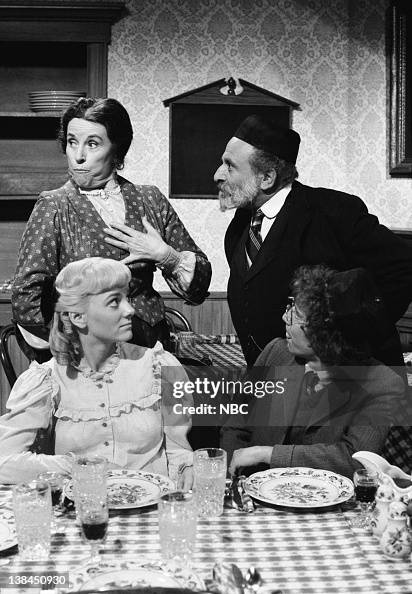
His parents, Benjamin and Edna Cohen, arrive to meet their expected grandchild and immediately clash with Nellie’s mother, Harriet Oleson. The central dispute concerns the religious upbringing of the baby. Benjamin insists the child must be Jewish; Harriet insists the child should be Christian.
What follows is one of the most openly Jewish storylines ever presented on a prime-time family drama of the era.
Benjamin speaks passionately about Jewish survival, reminding his son that throughout history others have attempted to destroy the Jewish people and that preserving Jewish identity matters.
For a network television audience in 1981, those were unusually direct references to Jewish history and collective memory.
The Remarkable Performance of Benjamin Cohen
The true star of the episode is E.M. Margolese, who portrayed Benjamin Cohen. Unlike many actors cast as Jewish characters in Hollywood, Margolese had authentic roots in Jewish culture.
Born Elias Mortimer Margolese in Montreal, he began acting as a child in the Montreal Yiddish Theatre.
This is particularly significant because Yiddish theatre was one of the most important cultural institutions in North American Jewish life during the first half of the twentieth century. Margolese was not simply performing Jewishness. He emerged from a specifically Jewish artistic tradition.
Before appearing on Little House on the Prairie, Margolese had accumulated a lengthy career, appearing in productions such as The Jeffersons, T.J. Hooker, MacGyver, The Powers of Matthew Star, and numerous Canadian television dramas.
His background gives the episode an authenticity that would otherwise be easy to miss.
When Benjamin argues with Harriet Oleson about Jewish continuity, one gets the sense that the dialogue is being delivered by someone who understood exactly what those concerns meant.
Edna Cohen: The Quiet Counterbalance
While Benjamin receives most of the attention, Bea Silvern’s portrayal of Edna Cohen deserves recognition.
Edna serves as the moderating influence within the Cohen family. She softens Benjamin’s fiery personality and represents a gentler expression of Jewish family life.
Her role is subtle but essential. Without Edna, Benjamin could easily have become a stereotype of the overbearing father. Instead, the Cohen family feels balanced and believable.
Although little biographical information is readily available about Silvern herself, her performance adds warmth and humanity to every scene she shares with Margolese.
Percival Cohen: The Jewish Son Caught Between Worlds
The third major Jewish character is Percival himself, portrayed by Steve Tracy.
Percival occupies a position familiar to many Jews navigating modern life. He loves his Jewish parents and respects their traditions, yet he has married outside the faith and built a life within a largely non-Jewish community.
In many ways he represents assimilation before the term became a major topic of communal discussion.
The conflict between Percival and Benjamin is therefore more than a family dispute. It reflects a broader question faced by countless Jewish families:
How does one maintain Jewish identity while participating fully in the wider society?
The episode does not offer a deep theological answer, but it deserves credit for raising the question.
The Halachic Problem Nobody Mentioned
For all its good intentions, the episode contains a theological wrinkle that Jewish viewers will quickly notice.
The entire conflict assumes that one child can simply be designated Jewish while the other is designated Christian.
Under traditional Orthodox Jewish law, however, Jewish status is inherited through the mother.
Since Nellie is not Jewish, neither child would ordinarily be considered Jewish according to traditional halachic standards, regardless of Percival’s Jewish identity.
Ironically, this means the compromise celebrated by the characters would not fully resolve the issue within traditional Judaism.
This is not really a flaw in the episode. It simply reveals that the writers were interested primarily in identity, culture, and family harmony rather than the finer points of rabbinic law.
Still, for Jewish viewers, it is impossible not to notice.
One might even joke that everyone in Walnut Grove left satisfied except the rabbi who was never invited to the conversation.
Harriet Oleson Finally Meets Her Equal
One of the episode’s greatest pleasures has nothing to do with religion.
For years, viewers watched Harriet Oleson bully and dominate nearly everyone around her.
Benjamin Cohen is one of the few people who refuses to be intimidated.
Their verbal battles are among the funniest moments in the season. Each is absolutely convinced of their own correctness. Each is fiercely protective of family. Each possesses an almost supernatural level of stubbornness.
In many respects, Benjamin Cohen is the Jewish Harriet Oleson.
That is exactly why the episode works.
The Supporting Cast and Jewish Representation
The episode also benefits from a cast capable of treating the material seriously.
Katherine MacGregor’s performance as Harriet avoids reducing the conflict to religious bigotry. Harriet’s objections stem primarily from family loyalty and personality rather than hatred.
Richard Bull’s portrayal of Nels Oleson provides balance and common sense amid the chaos. Ultimately, he helps broker the compromise that temporarily resolves the dispute.
Meanwhile, Alison Arngrim and Steve Tracy portray a young couple attempting to maintain peace between competing family traditions.
Remarkably, the writers never portray Jewish identity as something strange or threatening. Instead, they present it as an enduring tradition worthy of respect.
For a family show airing in 1981, that was meaningful.
The Twist Ending
Naturally, this being Little House on the Prairie, events resolve themselves through an improbably convenient miracle.
Nellie gives birth to twins, a boy and a girl. The families agree that the boy will be raised Jewish and the girl Christian.
Is this realistic?
Not particularly.
Is it charming?
Absolutely.
The ending may not satisfy a halachic authority, but it perfectly satisfies the emotional needs of a prairie drama.
Why This Episode Still Matters
Viewed today, Come, Let Us Reason Together is a fascinating time capsule.
It demonstrates that mainstream American television could discuss Jewish identity, assimilation, religious continuity, and interfaith families long before such topics became commonplace.
More importantly, it does so sympathetically.
The episode acknowledges differences without demonizing either side. Benjamin Cohen’s concerns are presented as legitimate. Harriet Oleson’s attachment to her own traditions is also treated seriously.
The message is not that one side must win.
The message is that families survive by finding ways to live together despite their differences.
More than forty years later, that lesson still resonates.
Author’s Note
While Come, Let Us Reason Together presents Jewish identity sympathetically and introduces many viewers to Jewish traditions, it approaches Judaism largely as a matter of culture and family heritage. From a traditional Orthodox perspective, the episode’s proposed compromise would not resolve the religious status of the children, since Jewish status is traditionally inherited through the mother. Nevertheless, the episode deserves credit for treating Jewish concerns with respect and presenting Jewish continuity as a legitimate and important value.
TooJewish Rating
★★★★½ out of ★★★★★
A surprisingly thoughtful exploration of Jewish identity hidden inside a prairie family drama. Featuring an actor with roots in Montreal’s historic Yiddish theatre, one of television’s most memorable Jewish guest characters, and a story that remains relevant to interfaith families today, this may be the most Jewish hour ever produced in Walnut Grove.
Sources & Further Reading
- IMDb episode listing: Little House on the Prairie Season 7, Episode 13, “Come, Let Us Reason Together.”
- IMDb full cast and production credits for “Come, Let Us Reason Together.”
- Little House on the Prairie Wiki: Episode 713, “Come, Let Us Reason Together.”
- TVMaze episode guide and cast listing.
- IMDb biography for E.M. Margolese.
- Find A Grave memorial and career summary for E.M. Margolese.
- Muppet Wiki biography of E.M. Margolese, including his early involvement in Montreal Yiddish Theatre.
- Historical background on Yiddish Theatre in Montreal and Canadian Jewish performing arts history.